Category: Construction Contract

  • Small Projects, Big Clarity: How to Structure Construction Contracts

    Small Projects, Big Clarity: How to Structure Construction Contracts

    Planning to start a G+3 residential building construction, build a small bridge in a village, or set up a warehouse for your factory? At first, projects like these may feel simple. But without a clear agreement, things can quickly slip into confusion, delays, or even disputes. This blog explains the basics of construction contracts for small projects and how to draft one—so you can keep your project running smoothly and build with confidence.

    Before diving into this subject, we have covered the importance and types of construction contracts in our articles listed below:

    One needs to understand, small projects are as complex and difficult as big projects. The only difference is that small projects can be understood and managed with help of one or two professionals. The following points are very important for people who do not have experience in construction or non-professionals.
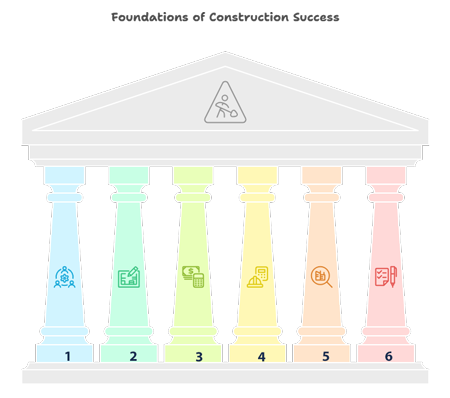
    1. Teamwork: construction is not one person job!
    2. Planning: construction needs strategic preparation.
    3. Budget: construction requires a lot of money.
    4. Time Management: efficient scheduling and deadlines will determine timely completion.
    5. Quality Control: construction quality need to be checked and controlled.
    6. Documentation: construction shall keep accurate records and reports.

    This articles assumes planning and design stage of your project is complete and well documented. Before you start construction,  you need well drafted and signed construction agreement.

    How shall I draft a construction agreement for my project then?

    The answer to this question is: You do not draft your agreement unless you are a contract engineer or construction lawyer. You only need to understand the agreement very well since you are going to sign on it. The following sections clarify the different aspects of construction agreements and finally provide templates that can be modified to your need.

    Key Parties Involved in Construction Agreements

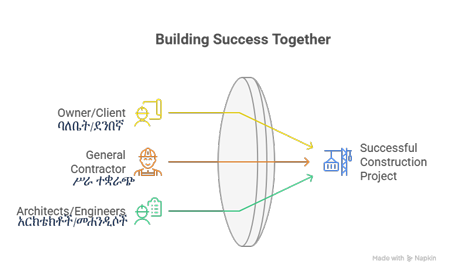
    Construction contracts typically bring together several players:

    • Owner/Client: The person or organization funding the project
    • General Contractor: The primary builder responsible for day-to-day operations
    • Architects/Engineers: The design and supervision professionals
    Main Types of Construction Contracts

    Type of construction contract need to be decided before drafting any contract. The following are the five major construction contracts as explained on our article.

    Lumpsum Contract or Fixed Price Contract

    Unit Price Contract

    Time and Materials Contract

    Cost-Plus Contract

    Design-Build Contract

    Legal Framework Governing Construction Contracts

    Construction contracts require legal frame work to exist. They’re shaped by:

    • Local building or construction codes
    • Industry standards and best practices
    • Contract law principles
    • Licensing requirements

    Different locations have different rules. That’s why having region-specific knowledge is crucial when drafting these agreements.

    Key Elements of Your Contract

    The following are the key elements of your construction contract which shall be included in the signed document

    Project Details:- Project name and identification reference shall be decided. Specific location of the project site and parties involved (Owner, Contractor, Consultant, and so on) shall be identified.
    Scope of Work:- Detail project description of all material, labor, and professional requirement need to presented. Design documents, specifications, and all reports need to be documented.
    Duties and Responsibilities: – Who is responsible for what? Obligations and tasks shall be assigned to each party of the contract.
    Payment Terms: – the total cost of construction need to be estimated and agreed on; when payments are going to be settled; how much advance and retention; method of payment; and so on.
    Project Schedule: – Clear schedule of when the project starts and when it is going to be completed. What if delay occurs and how to extend the completion date.
    Change Orders: – How do you manage changes in design or government requirements during construction. How to estimate the cost of the change in construction.
    Quality: – A method need to be devised to insure quality of construction. Selecting standards in relation to quality assurance.
    Dispute: – A step by step procedure shall be set for handling disagreements and disputes.
    Termination: – The construction project could be faced with various challenges which can lead to termination by one party or both. Devising a method to handle this termination is vital.

    The description you prepared can be summarized and constituted into an agreement.

    Drafting your Construction Contract Agreement.

    There are two options for drafting your contract document

    OPTION A

    Hire a professional or an expert and provide him with your description of the project as outlined above. He/she will prepare a draft document for you.

    OPTION B

    You can also get sample templates for an extra fee from this website. These templates are drafted for a residential building, small bridge and internal roads. And, you can modify it with a professional.

    Summary

    Preparing a carefully drafted contract document for your small project will create big clarity to all parties of the construction. It is also vital to introduce a professional in your project. Well prepared and signed construction contract document on your project will save you from confusion, delays, or disputes which could come through time.

    Share your ideas with our community via the comment box below.

    OR

  • Building Trust: Drafting a Simple Construction Agreement

    Building Trust: Drafting a Simple Construction Agreement

    Are you planning to renovate or maintain your house; or build a new fence; or cover your outdoor surface with terrazzo; or construct a ditch for rain storm; etc. Or, you are a contractor to do these works.

    What if I’m going to tell you that there is an important and smart way to begin these projects. Preparing a simple construction contract agreement.

    On our article “Understanding Construction Contract Agreements: A Beginner’s Guide”, we have discussed construction contract agreement briefly and why it is very important to your construction work. We also categorized projects based on their complexity as easy, simple, medium, and big. The above works shall be categorized as easy projects.

    In this article, we shall show you how to draft a simple contract agreement. This agreement shall build trust and confidence in your project so that your project can be completed successfully.

    Do I really need a construction agreement?

    You may be asking, why do I need an agreement for that

    I am only constructing 20 meter masonry ditch and I only deal with one mason

    I am building a G+2 residential building and the contractor is my brother’s best friend

    I am going to construct a building for very famous/reputable rich man in town

    I am working with government office and the manager told me to start without agreement

    Well, you can raise a wide variety of similar questions. The answers can be given with the following very simple questions. How do you feel, if

    the house to be completed within 3 months took 3 years, and still it is not complete

    your friend contractor took advance payment and disappears

    Your rich relative is not willing to pay for completed building

    The constructed masonry ditch is washed away by flood

    The world is full of the above and similar cases. And, people faced with these situations have felt anger, frustration, and resent most of the time. So, do you need a contract agreement for your construction works? The simple and obvious answer is YES!

    How shall I draft a construction agreement for my project then?

    To draft an agreement for your easy project is very simple. Answer the following questions on a piece of paper.

    • Who is owner and contractor of the project? Attach documentation for each party

    For example: Valid ID, Renewed Business license, and so on

    • What do you want to construct? Clearly write your vision of the work to be done.

    For example: “I want hollow block fence around a house. It should be similar to the height of the neighbor. It shall be done with quality hollow block. The color of the fence shall be gray. And, all waste must finally be cleared.”

    • How much is the cost of construction? Probably ask a friend, relative, or join our forum.

    For example: “Since I supply material, compare labor cost of the contractor”

    • When do you want it to be completed? Set a realistic time line.

    For example: “I want it to be completed with 1 month or two weeks time”

    • What are the payment terms? Most appropriate can be advance and final payment.

    For example: “Pay 40% as an advance and 60% at completion of work”

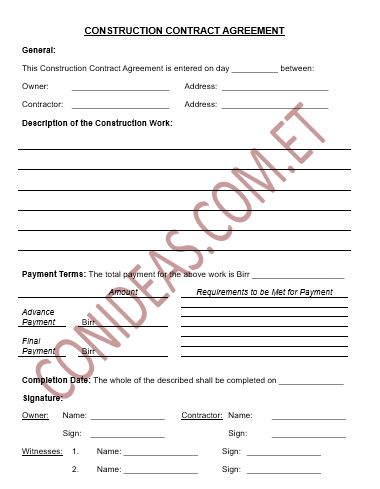
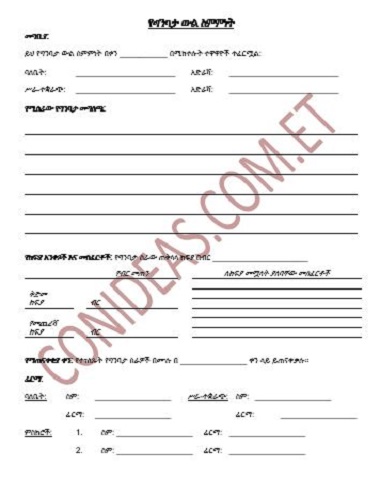
    Let’s simplify the above into actual agreement paper as shown in the image below.

    The answers you prepared can be summarized in the above agreement. Please be careful in using fancy, complicated or legal words which can backfire on yourself. A contract agreement shown above should be written in a very clear and simple language so that everybody can understand.

    In conclusion,

    A simple construction contract agreement shown above for easy construction projects has the following vital advantages.

    • The project work scope is very well understood between the owner and builder as long as genuine negotiations are made.
    • The cost of the project is also stated in figures
    • The completion time of the project is also known
    • It is legally acceptable document in case of disagreement

    It’s believed that disagreements between builder and owner could arise. The best way to settle these disagreements is through discussion and negotiation.

    A simple contract shown above will save you a lot of trouble in case things did not go as planned. You can just use a white paper and a pen just to jot down the above agreement in hand writing.

    Finally, simple projects, like house renovation/maintenance, residence villa/building, small internal road, and small bridge constructions; require professional contract agreement form and documents. You can read our article Small Projects, Big Clarity: How to Structure Construction Contracts.

    Share your ideas with our community via the comment box below.

    OR
  • Understanding Construction Contract Agreements: A Beginner’s Guide

    Understanding Construction Contract Agreements: A Beginner’s Guide

    We all see some type of construction in our daily life. And, most of us have been involved in construction work. Whether doing fence masonry; painting of family house; construction of building/bridge; or a big dam; these all fall in into construction category with of course wide range of complexity.

    It should be interesting to note that the words we use in complex construction works are very similar to simple constructions. For example, masonry -> masonry; concrete -> concrete; roof -> roof; and contract agreement –> contract agreement.

    In this article, we shall discuss construction contract agreement briefly and why it is very important to your construction work. Finally, you shall be able to draft an agreement for your construction project.

    What is construction contract agreement?

    A construction contract agreement is a written understanding between two parties to build or construct a civil engineering or related work. Now, who are these two parties? Look at the following pictures.

    Relation ShipParty 1
    (Owner)
    Party 2
    (Consultant or Contractor)
    1Individual (like Abebe, Chaltu)Individual (like Teshome, Almaz)
    2Individual (like Abebe, Chaltu)Company (AGY Consultant or Extreme General Contractors)
    3Private Business (ZTY Supermarket)Individual (like Teshome, Almaz)
    4Private Business (ZTY Supermarket)Private Business (ZTY Supermarket)
    5Government Organization (AA Housing)Individual (like Teshome, Almaz)
    6Government Organization (AA Housing)Private Business (ZTY Supermarket)

    As can be seen above, the first party (Owner/Client) want to build something while the second party will be the builder (Contractor). When these two parties agree and sign a piece of paper for a construction work, they have formed or committed a construction contract agreement.

    What are the benefits of a construction agreement?

    Construction in general is a complex undertaking. It involves two or more people to complete a project. Having written and signed contract documents shall have the following benefits

    • It clearly explains what work will be done, who is responsible for what, how long the project will take, and how much it will cost
    • It serves as a legal document for both the owner and the contractor
    • If something goes wrong or there’s a disagreement, the contract can be used to solve the problem fairly
    • It makes sure payments are made properly and on time, and it can include penalties for late work or rewards for finishing early
    • It also helps the project run smoothly by setting clear deadlines and steps to follow

    Can I prepare a construction contract agreement for my project?

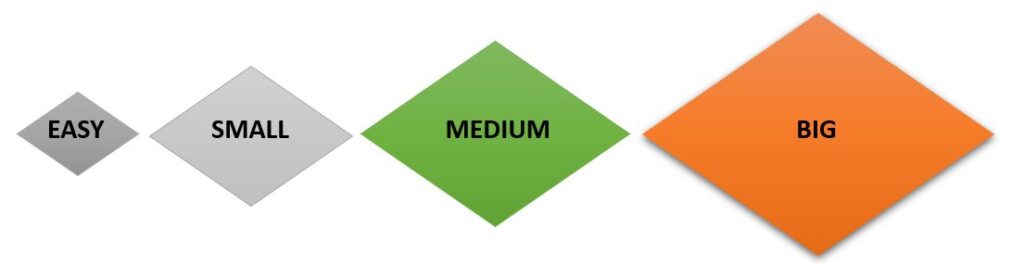
    In order to give you an answer, we first need to classify your project into one of the following complexity categories.

    project complexity categories illustration

    EASY: This is a type of construction where one or two skilled-manpower (mason, electrician, plumber, etc.) are involved. House paintings, ditch construction, fence construction, house maintenance, and so on are examples of easy construction. In this case, you may assign yourself as owner and project manager even if you don’t have experience in construction.

    SMALL: House renovation/maintenance; residence villa/building; small internal road; and small bridge constructions can be included into this group.  These construction works involve more than two skilled-men power with professionals. In this case, you may assign yourself as owner and project manager but you definitely need an experienced professional adviser. It may also be wise to assign a professional as project manager.

    MEDIUM: These are projects with wide scope compared to small projects. Medium rise buildings (five to twelve stories), small factories, medium span bridges, small dams, and so on fall into this category. These projects require dedicated individual professionals and companies to manage, supervise, and construct. It is highly recommended for the owner not to be a project manager. A qualified professional or company shall manage these projects.

    BIG: From medium to high-rise buildings (more than twelve stories) to highways to bridges to dams; all shall fall under this category. These projects are highly complex and difficult to manage/construct in which competent companies with specialized experience are required.

    How shall I draft my construction contract agreement?

    Based on the above complexity categories, you shall prepare a contract document for easy projects only. We have prepared a step by step guide for you on our article “how to draft a simple construction contract agreement”. You can also draft an agreement together with a professional for a small project too. Please read our guide on our article “how to prepare a formal construction contract agreement”. For medium and big projects, it is highly recommended to hire professional companies on this matter.

    In conclusion,

    A good construction contract isn’t just legal protection—it’s peace of mind. For owners, contracts provide quality guarantees and remedies if things go wrong. For contractors, they ensure fair payment terms and clear work expectations.

    Share your ideas with our community via the comment box below.

    OR